Square teak table by Pierre Jeanneret, model PJ-TA-04-A, from the Chandigarh furniture program, circa 1959–1960. The broad square top and four straight timber legs create a compact, clearly proportioned form with surviving institutional lettering along the edge.
Jeanneret’s furnishings were integral to the architectural and institutional life of Chandigarh, the new city developed in post-independence India. Tables and desks translated the requirements of study, administration and communal activity into a concise vocabulary of timber construction. Working with local craftsmen, Jeanneret treated the surface and its supporting members as a complete composition. These objects share the directness of his seating designs, while their different proportions reflect the particular demands of writing, reading, dining and the organization of everyday work.
The legs stand close to the corners, leaving the space beneath the top largely open. The substantial edge and exposed timber grain give the horizontal plane a strong presence, while the unadorned supports maintain the practical character of the construction. Surface abrasion, marks and variations in color are particularly visible across the top.
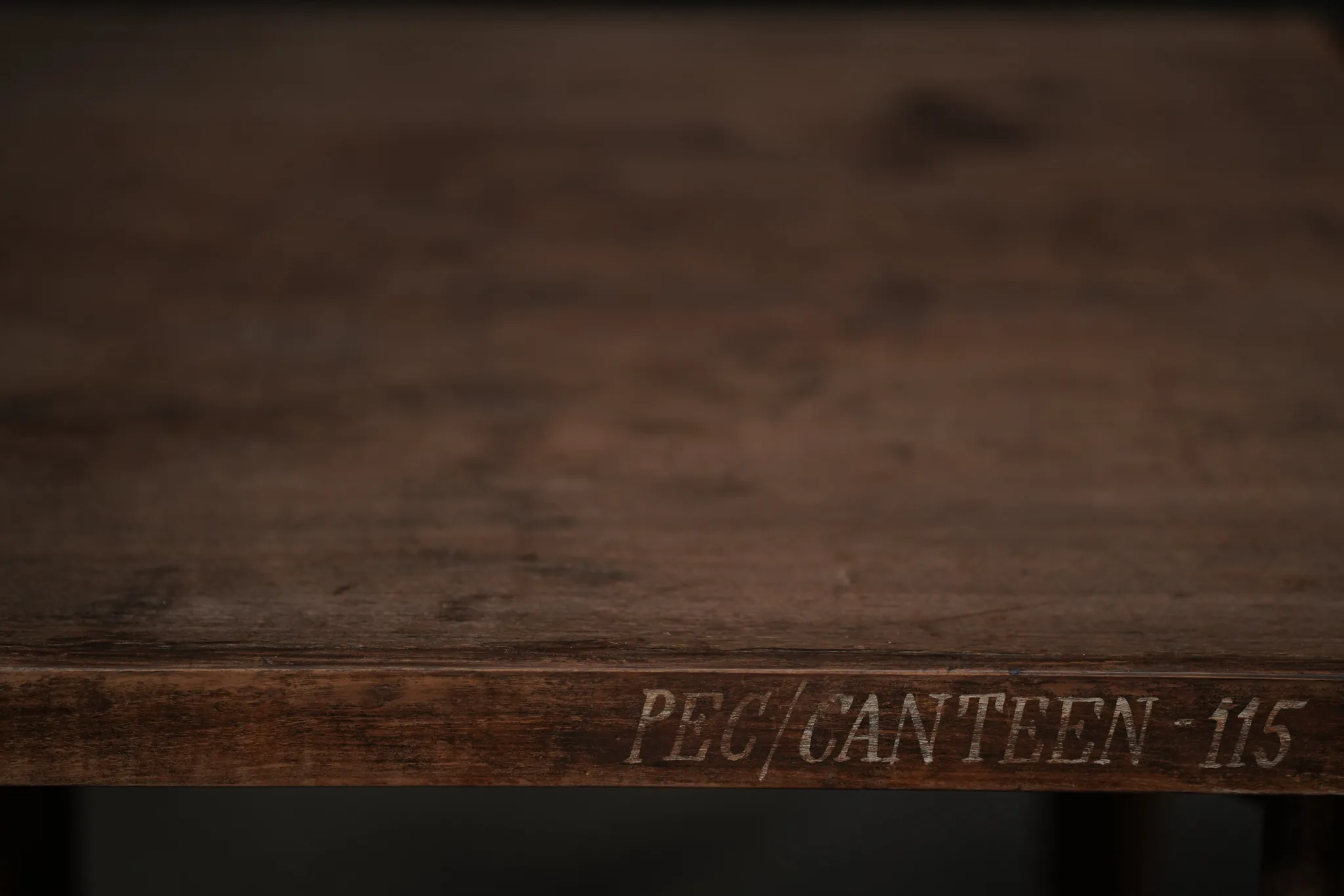
The photographed edge reads “PEC/CANTEEN-115.” PEC is consistent with Punjab Engineering College, which moved to its Chandigarh campus in 1953; “CANTEEN” explicitly identifies a communal dining context. The inscription is an inventory designation on the table itself and adds a specific institutional association to its material history. The number 115 remains part of that surviving identifier.
The vintage teak retains variations in grain, color and surface wear, with softened edges and individual traces of use visible in the photographs. These details give the woodwork its material character and preserve the sense of a furnishing made for daily life in institutional or residential interiors.
A related square table of this model is documented by Sotheby’s in Design, December 2022, lot 460, with a reference to Touchaleaume and Moreau, L’Aventure indienne, 2010, pages 359 and 585.
Dimensions: approximately 35.75 inches wide, 35.75 inches deep, 28.5 inches high.
Provenance: private collection, Chandigarh, India, as recorded by Studio Balestra.
Accompanied by a Studio Balestra Certificate of Authenticity.