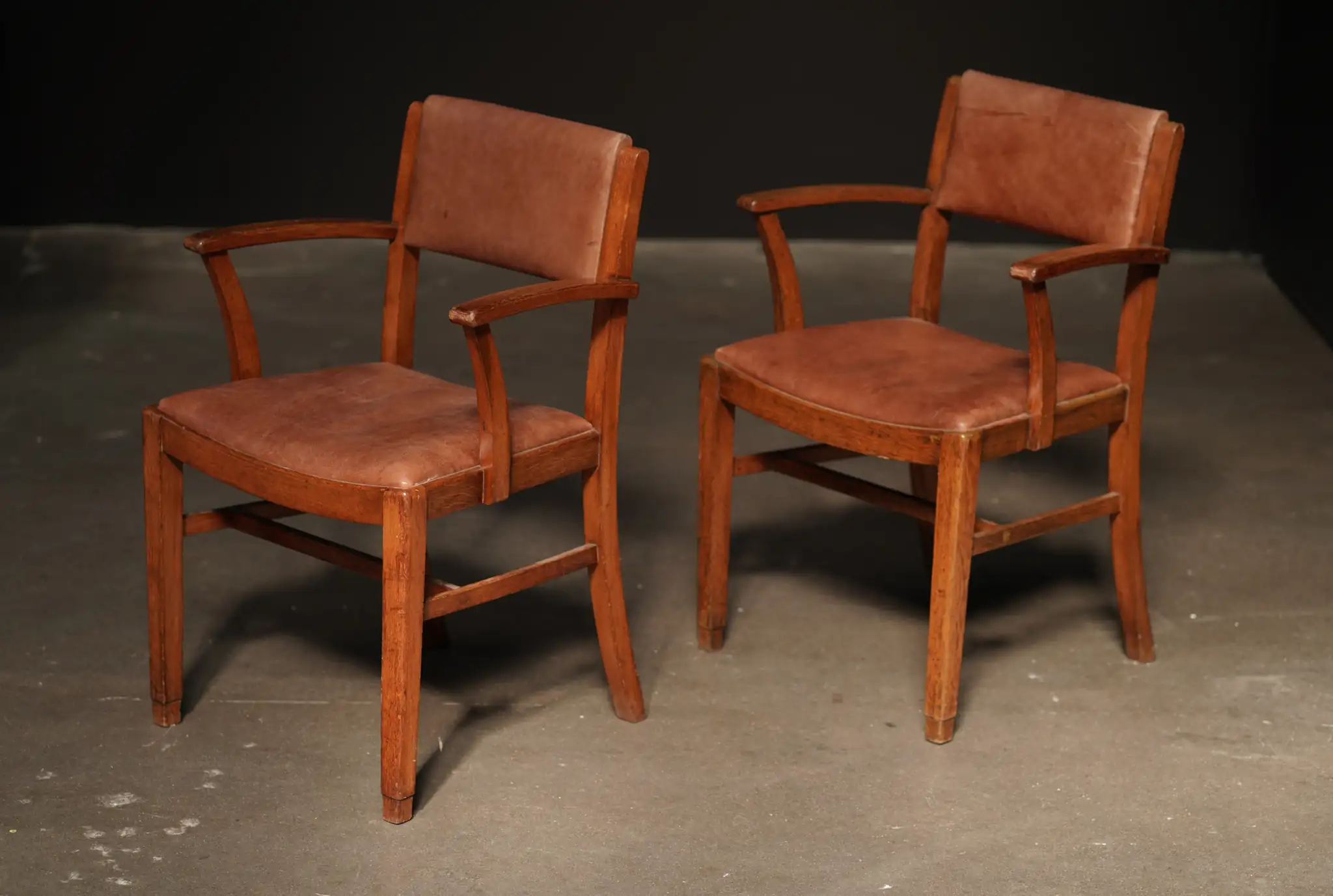
Floating-back office armchairs by Pierre Jeanneret from the Chandigarh furniture program, circa 1955–1956. Broad teak armrests sit above compass-form side supports, framing woven cane seats and rectangular backs in an open, distinctly architectural composition.
Jeanneret developed furniture alongside the architecture of Chandigarh, the new city created in post-independence India. Seating was an essential part of its offices, educational establishments and residential interiors. His designs brought modernist composition into direct contact with local woodworking: substantial timber members, economical joints and repeated forms gave ordinary furnishings a distinct architectural presence. The resulting furniture was made to be used, and its character emerges from the way a relatively small number of structural elements organize the body, the supporting frame and the spaces between them.
The back panel is separated from the rear seat rail by a band of open space. The inclined timber supports spread outward to form a stable base, while the flat armrests extend forward beyond the frame. The cane grid provides a lighter surface within the warm, substantial teak outline.
A photographed rear rail retains “I.B.H.O(Pb)734” lettering. The administrative initials and Punjab abbreviation preserve an institutional inventory association, while the number identifies an individual entry within that system. The paint remains visible alongside the grain and wear of the teak, adding a specific historical detail to the chair’s otherwise restrained construction.
The vintage teak retains variations in grain, color and surface wear, with softened edges and individual traces of use visible in the photographs. These details give the woodwork its material character and preserve the sense of a furnishing made for daily life in institutional or residential interiors. The timber has been refinished. The present cane weaving is renewed.
Dimensions: approximately 20.25 inches wide, 20 inches deep, 30.25 inches high.
Provenance: private collection, Chandigarh, India, as recorded by Studio Balestra.
Accompanied by a Studio Balestra Certificate of Authenticity.