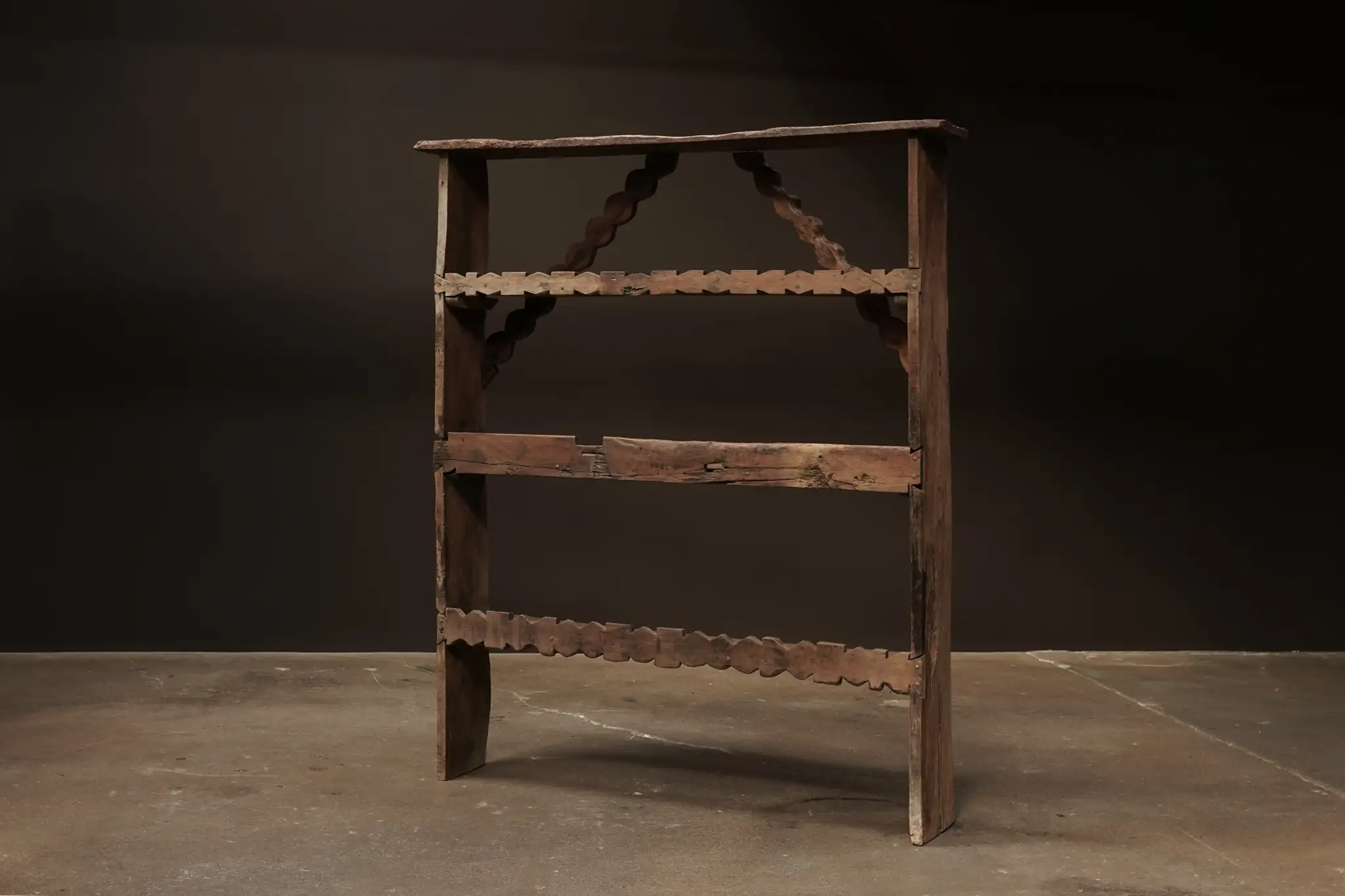
Compact teak file rack by Pierre Jeanneret, a variant of model PJ-R-27-A, from the Chandigarh furniture program, circa 1957. Six open compartments are organized within a rectangular case, creating an economical structure for files, books and papers.
The furniture developed by Jeanneret for Chandigarh extended to the practical organization of the city’s institutions and residences. Storage was treated with the same architectural clarity as seating and tables: timber frames, repeated compartments and straightforward fittings made the function of each piece visible. Made in the context of post-independence India’s new city, these furnishings brought modernist ideas into a vocabulary of local woodworking and everyday materials. Their identity lies in the relationship between the enclosing case, its openings and the objects it was intended to hold.
Three vertical bays are divided by shelves at alternating heights. Both faces remain open, allowing the partitions and shelf edges to be seen clearly. Solid end panels frame the arrangement and extend below the lowest shelf to provide the supports, keeping the entire object within a simple rectangular outline.
The 36-inch width gives this example a concentrated scale while preserving the rhythm of the staggered compartments. The long top ties the different openings together, and the depth allows the rack to retain a relatively slender profile. The photographed teak has uneven coloration, worn edges and residual surface traces that give the individual casework a distinct visual history.
The vintage teak retains variations in grain, color and surface wear, with softened edges and individual traces of use visible in the photographs. These details give the woodwork its material character and preserve the sense of a furnishing made for daily life in institutional or residential interiors.
Related compact PJ-R-27-A file racks are documented in Sotheby’s design catalogues; the model family is illustrated in Touchaleaume and Moreau, L’Aventure indienne, 2010, page 596.
Dimensions: approximately 36 inches wide, 13 inches deep, 30 inches high.
Provenance: private collection, Chandigarh, India, as recorded by Studio Balestra.
Accompanied by a Studio Balestra Certificate of Authenticity.